 Hannah Ostrem
Pulsara Around the World - October 2026
 Audrey Peart: Sep 30, 2026
September Recap After a light summer, our events schedule is ramping back up for the final months of 2026. With 10 shows under our belt this month...
![Australian Health System Achieves Faster Treatment for Every Stage of Patient Journey With Pulsara [Preliminary Research]](https://www.pulsara.com/hubfs/new-patient-assigned-to-doctor.gif)
Editor's Update: The research project and preliminary research findings discussed in this blog post have concluded, and the final research findings have been published. View the subsequent published research studies here:
Research Study: Real-world, feasibility study to investigate the use of a multidisciplinary app (Pulsara) to improve prehospital communication and timelines for acute stroke/STEMI care
BJM Open | 18 July 2022 | https://bmjopen.bmj.com/content/12/7/e052332
Research Study: Factors influencing the successful implementation of a novel digital health application to streamline multidisciplinary communication across multiple organisations for emergency care
Journal of Evaluation in Clinical Practice | 18 September 2023 | https://doi.org/10.1111/jep.13923
Teams at the Florey Institute of Neuroscience and Mental Health in Victoria, Australia are setting new care standards for patients suffering suspected stroke or STEMI.
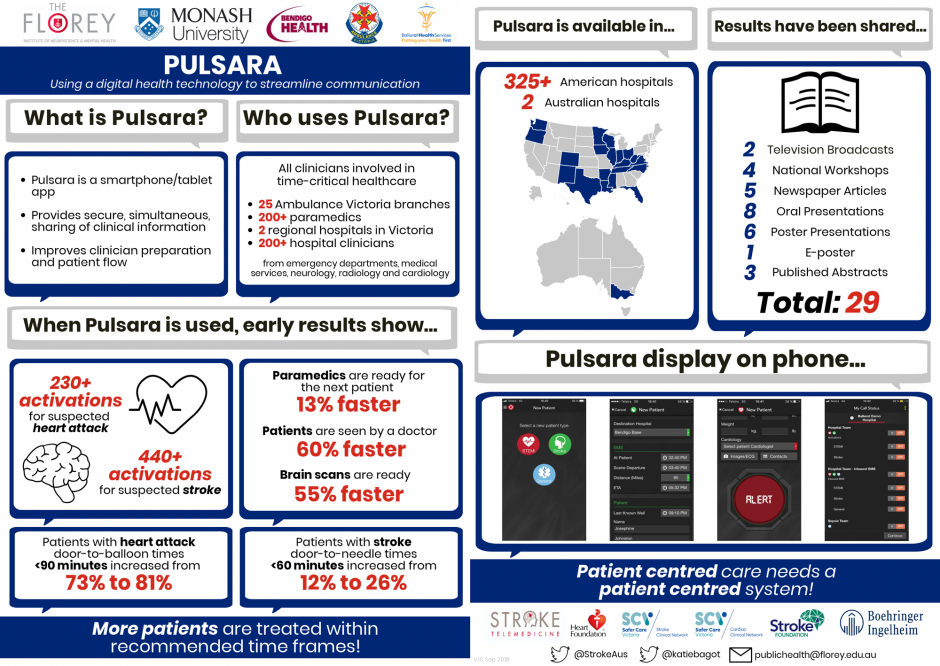
"Preliminary results show that every stage of the patient journey is faster when Pulsara is used."
As part of their "Pre-Hospital Real-time cOMmunication using Pulsara Technology (PROMPT) Project", the care teams have implemented Pulsara to determine whether the platform can help improve treatment times for critical conditions by facilitating communication between and among EMS teams and care teams at the hospital.
Pulsara is quickly dominating the United States healthcare space as the only regional communication network for healthcare, but the platform is now widely used in Australia too. Researchers of the PROMPT project recently unveiled their preliminary findings.
The project examined "25 Ambulance Victoria branches involving more than 200 paramedics, and 2 regional hospitals, Bendigo Health and Ballarat Health Services, involving more than 200 in-hospital clinicians from emergency departments, neurology, cardiology and radiology."
In addition to finding faster treatment throughout the entire patient journey, the preliminary results of the PROMPT project also show an increase in the proportion of patients who are being treated within the recommended time windows.
Pulsara is humbled and excited about these results, and extends a huge congratulations to the Ambulance Victoria, Bendigo Health, and Ballarat Health Services teams, as well as to PROMPT project supervisor, Dr. Christopher Bladin, and Project member Dr. Kathleen Bagot for their work!
 Audrey Peart: Sep 30, 2026
September Recap After a light summer, our events schedule is ramping back up for the final months of 2026. With 10 shows under our belt this month...
 Audrey Peart: Jul 30, 2026
July Recap Supporting Medical Response with Connected CommunicationBetween World Cup matches and fan events, fire/EMS, hospital, and emergency...